
The shed isn’t about the shed.
Australia has more than 1,300 Men’s Sheds. The woodwork was never the point.
- 1,300+Men’s Sheds across Australia. The association reckons that’s more than Macca’s.AMSA, n.d.
- Twicethe risk of suicidal thoughts and plans, roughly, for Australian men reporting high loneliness.AIFS, 2025
- 29.7%of Irish shed men scored as lonely in June 2020, with restrictions on. Asked about before restrictions: 1.4%.McGrath et al., 2021
Nobody signs up for loneliness
The first Men’s Shed opened in Goolwa, South Australia, in 1993. More than 60,000 Australian men now take part. Sheds vary, but the usual setup is tools, a kettle and a job that needs doing. You don’t walk in and announce you’re lonely. You say the bench needs fixing.
Then this happens. A shed coordinator, quoted in a 2022 review of 52 studies:
“The first day they stand shoulder to shoulder, working, with their attention to the task at hand. The next day they continue, but start talking to each other…”
Shed coordinator, in Foettinger et al., 2022
The partners noticed too. One member’s wife told researchers: “The Shed allows me to have space and freedom to do my own thing.” Everybody wins.
He’ll tell you he’s fine
Australia’s long-running household survey, HILDA, tracked 12,117 men aged 15 to 98 across 20 rounds. Researchers asked about loneliness two ways. Ask a man straight whether he often feels very lonely, and he scores lower. Come at it sideways, with several indirect questions, and he scores higher, at every age. The authors say that fits other evidence: men under-report it when asked directly.
On average it’s highest around middle age, eases from 50, and climbs again from 70. So it isn’t only an old bloke’s problem.
It matters beyond a quiet weekend. In Australia’s Ten to Men study, men reporting high loneliness carried around twice the risk of suicidal thoughts and plans. Loneliness stayed linked after allowing for unemployment and how disadvantaged their area was. That’s a link, not a verdict, and no one thing explains why anyone reaches that point.
The membership card isn’t it
Here’s the part we didn’t expect. In the HILDA men, being a member of a club or hobby group wasn’t related to loneliness in any age group. Across all ages together there was a faint link, and that’s all. Seeing friends and family more often went with less loneliness at every age. So did having a partner and liking your neighbourhood. Men who held harder to the idea that the bloke must be the breadwinner were lonelier.
The researchers say this can’t prove cause. But read it the practical way: the card in your wallet isn’t the thing. Turning up, week after week, to the same faces is.
What sheds do, on the evidence
That review covers 52 studies, 28 of them Australian. It found benefits for how men rate their health, for isolation and for wellbeing. In one study, 90.4% of members felt they belonged more since joining. One of them put it plainly: “It’s a great place for people to come instead of sitting at home or who are lonely.”
Another review, of 16 papers, counted what kept coming up. Stronger bonds and friendships in 11. More reason to leave the house and keep a routine in 9. Less isolation in 9. Fewer suicidal thoughts and less depression got a mention in 10, though only from a small number of men in each.
Now the bit the brochure skips
None of that is proof. A 2016 review said so flat out: “there is no conclusive evidence” that sheds and similar programs deliver health and wellbeing benefits to older men. The 2022 review says most of the numbers come from home-made questionnaires, a single point in time, and little attempt to rule out other explanations. Men who join may already be the ones with the get-up-and-go. And these reviews are about older men, mostly retired, so they can’t tell you much about a 30-year-old.
When Ireland tested a 10-week health program inside sheds, with 421 men, wellbeing went up. Loneliness scores didn’t shift because of it. Maybe those men had the shed already. Which brings us to the closest thing to a test we found.
Then the doors shut
That Irish study was running when COVID closed the sheds. Nobody planned that. In June 2020, by phone, researchers asked the men how lonely they felt now and how lonely they’d felt before restrictions. Before: 2 men, 1.4%. Now: 43 men, 29.7%. Men living alone were lonelier. One said:
“I miss the cups of tea and the few biscuits… My world has become ‘very small’ with COVID and health issues.”
Shed member, Ireland, in McGrath et al., 2020
Everyone was locked down that year, shed or no shed, so the sheds can’t take all of that, and “before” is what men remembered. The authors still concluded the findings suggest sheds protect against loneliness. It’s not a clean experiment. It is what it looks like when you take away the cup of tea.
So the evidence says: promising, unproven, and the mechanism is about as complicated as a kettle. Have somewhere to be. Have a job to do when you get there. Have the same blokes there next week.
If it’s a mate
Don’t ask if he’s lonely. You read what he’ll say. Ask him to hold the torch. “Got a job on Saturday, need a hand.” Then do it again next month.
If it’s you
There’s probably a shed closer than you think: find one here. Not your thing? Same idea, anything with a job, a regular time and the same faces. Footy club canteen, Landcare, a mate’s fence.
And if tonight’s a rough one, you don’t need to wait for Saturday. These run around the clock:
- Text Lifeline: 0477 13 11 14
- Ring Lifeline: 13 11 14
- Online chat or video: MensLine or Suicide Call Back Service
In danger now: 000.
Every number we’ve gotWhere this comes from
- Australian Institute of Family Studies. (2025). Submission 54 to the ACT Legislative Assembly Standing Committee on Social Policy. Summarises the Ten to Men study’s findings. parliament.act.gov.au/__data/assets/pdf_file/0010/2920546/Submission-54-Australian-Institute-of-Family-Studies.pdf
- Australian Men’s Shed Association. (n.d.). Facts & figures. Figures are the association’s own. mensshed.org
- Botha, F., & Bower, M. (2024). Predictors of male loneliness across life stages: An Australian study of longitudinal data. BMC Public Health, 24(1), 1285. pmc.ncbi.nlm.nih.gov/articles/PMC11088127
- Foettinger, L., Albrecht, B. M., Altgeld, T., Gansefort, D., Recke, C., Stalling, I., & Bammann, K. (2022). The role of community-based Men’s Sheds in health promotion for older men: A mixed-methods systematic review. American Journal of Men’s Health, 16(2), 15579883221084490. pmc.ncbi.nlm.nih.gov/articles/PMC8928410
- Kelly, D., Steiner, A., Mason, H., & Teasdale, S. (2019). Men’s Sheds: A conceptual exploration of the causal pathways for health and well-being. Health & Social Care in the Community, 27, 1147–1157. pmc.ncbi.nlm.nih.gov/articles/PMC6772158
- McGrath, A., Murphy, N., & Richardson, N. (2020). Sheds for Life: Insights into the impact of COVID-19 on wellbeing outcomes of Men’s Shed members [Conference slides]. mhfi.org/IMSA2020.pdf
- McGrath, A., Murphy, N., & Richardson, N. (2021). The impact of the COVID-19 pandemic on the wellbeing of Irish Men’s Shed members. Health Promotion International, 36(4), 1007–1019. academic.oup.com/heapro/article/36/4/1007/6017951
- McGrath, A., Murphy, N., Egan, T., & Richardson, N. (2022). Sheds for life: Health and wellbeing outcomes of a tailored community-based health promotion initiative for men’s sheds in Ireland. BMC Public Health, 22(1), 1590. pmc.ncbi.nlm.nih.gov/articles/PMC9392583
- Milligan, C., Neary, D., Payne, S., Hanratty, B., Irwin, P., & Dowrick, C. (2016). Older men and social activity: A scoping review of Men’s Sheds and other gendered interventions. Ageing & Society, 36(5), 895–923. doi.org/10.1017/S0144686X14001524
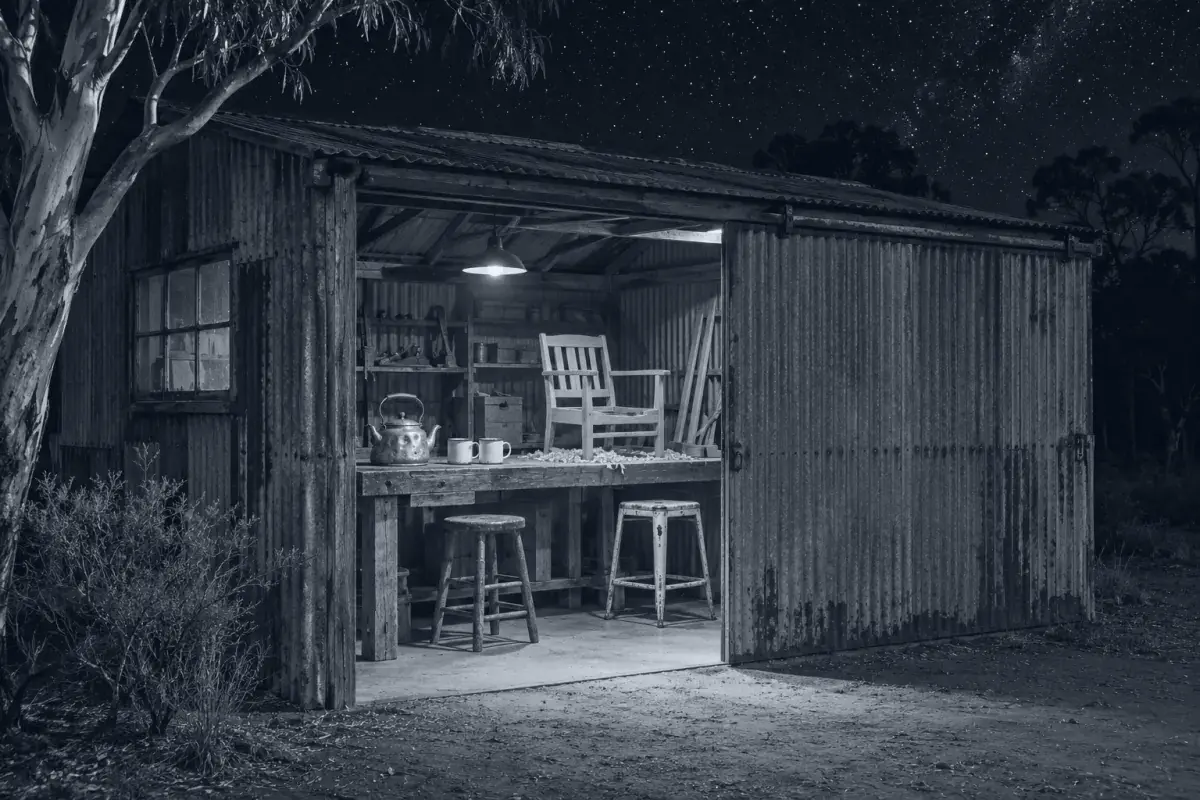
The picture is generated, not real blokes.